Push Yourself: More Than Just a Font for Athletes
If you’ve ever stared at a blank canvas trying to design a logo for a local sports team, a marathon flyer, or a gym's social media page, you know the struggle. You need typography that screams energy and movement, but most standard sans serif font options feel too corporate, and script font choices often lack the grit required for athletic branding. This is exactly the gap that Push Yourself fills. It isn’t just a typeface; it’s a visual representation of effort, sweat, and victory. Designed with a distinct sportive look and feel, this premium font captures the essence of physical exertion in its very curves and angles.
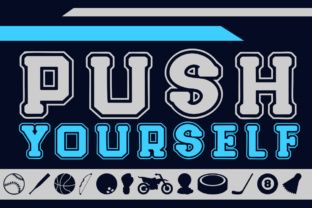
The visual personality of Push Yourself is bold and unapologetic. It carries the weight of a heavyweight champion but maintains the agility of a sprinter. When you look at the letterforms, you’ll notice they are designed to grab attention immediately. It functions primarily as a display font, meaning it shines brightest in headlines, logos, and large-scale typography where its unique characteristics can breathe. Unlike a serif font that whispers tradition and authority, Push Yourself shouts action. It’s the kind of typography that makes the viewer feel like they should be moving. However, what truly sets this typeface apart from other creative fonts on the market is its utility. It includes 26 lowercase sport-themed dingbats. This is a massive value-add for anyone in the creative space. Instead of hunting for separate vector assets or clipart to finish a layout, you have integrated design assets right inside your font menu. Need a soccer ball, a basketball, or a whistle? You simply toggle to the lowercase keys, and you have instant iconography that matches the weight and style of your text perfectly.
Real-World Application: Beyond the Jersey
While the name suggests athletics, the utility of Push Yourself extends far beyond the locker room. As a commercial font, its versatility lies in its ability to convey "challenge" and "growth." For entrepreneurs and marketers, this psychological trigger is gold. Consider a productivity app, a coding boot camp, or a motivational coaching business. These industries rely on the concept of pushing boundaries. Using this creative font in your web design headers or social media graphics instantly communicates that your brand is about progress and action.
For those involved in packaging design, particularly in the health food, energy drink, or fitness supplement sectors, the font provides an immediate shelf appeal. It acts as a visual shorthand for "active lifestyle." When a customer scans a shelf, a modern typography choice like Push Yourself can differentiate a product as being high-energy compared to the clean, sterile look of a standard sans serif font. Furthermore, crafters and hobbyists will find immense joy in using this for personal projects. Think about custom t-shirts for a family reunion softball game, iron-on vinyl decals for water bottles, or scrapbook layouts documenting a 5k run. The included dingbats make these projects significantly easier, allowing for quick customization without needing advanced design software skills to import separate graphics.
Design Strategy and Pairing
One of the most common mistakes in logo design and editorial design is using a display typeface for body copy. Because Push Yourself has such a strong, textured personality, it demands to be used sparingly and strategically. If you set a full paragraph in this font, the visual noise will overwhelm the reader, killing readability. The best practice is to use it for impact—headlines, sub-headers, and pull quotes—and then pair it with a neutral companion.
To create a balanced visual hierarchy, pair Push Yourself with a clean, geometric sans serif font or a highly legible serif font for your body text. The contrast between the energetic, rugged display font and the quiet efficiency of a standard text font creates a professional tension that holds the viewer's interest. For example, if you are designing a flyer for a charity run, the title "PUSH YOURSELF" should dominate the top in large, impactful letters. The details—date, time, registration link—should be set in a standard sans-serif like Helvetica, Roboto, or Open Sans. This ensures that your brand identity feels exciting but also accessible and easy to navigate.
Technical Considerations and Licensing
Before integrating any new asset into your workflow, due diligence is required. As a designer or content creator, you must evaluate the technical fit of the font. Because Push Yourself is a display font, kerning (the spacing between individual letters) is critical. In sporty typography, letters often overlap or connect to create a sense of speed. You will likely need to manually adjust the tracking and kerning in your design software to ensure the letters fit together seamlessly, especially in logo design where precision is paramount.
Regarding commercial licensing, always verify the terms of use. If you are a small business owner creating merchandise to sell—like t-shirts or mugs—you need to ensure the license covers physical end-products. Most standard licenses cover digital use (web, social), but selling a physical product often requires an extended license. This is a non-negotiable step in professional brand identity management. Ignoring licensing can lead to legal headaches that no amount of good design can fix.
Ultimately, Push Yourself is a specialized tool. It isn't trying to be everything to everyone, which is exactly why it works so well. It targets a specific emotional frequency—drive, competition, and energy. Whether you are a blogger looking to spice up a post about your fitness journey, a publisher designing a cover for a sports magazine, or a marketer launching a new activewear line, this font offers a ready-made solution. It combines the raw power of modern typography with the practical utility of built-in graphics, making it a valuable addition to any designer's library.