One Thousand: A Sans Serif That Commands Attention Without Shouting
There’s a moment in every design project where the typography either elevates the concept or quietly undermines it. You’ve been there—scrolling through endless font libraries, trying to find that one typeface that feels both distinctive and versatile, modern but not trendy, bold yet still readable. That’s the space One Thousand occupies, and it does so with a quiet confidence that’s hard to ignore.
What Makes One Thousand Different From the Crowd
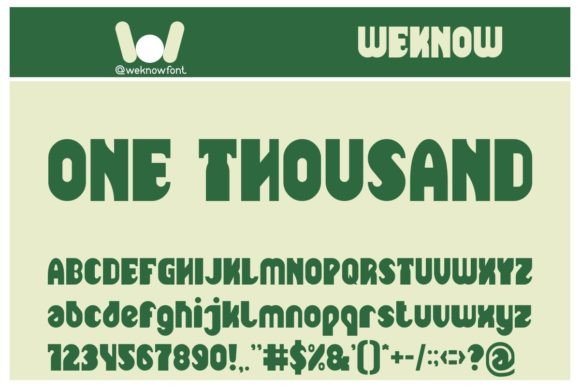
One Thousand is a premium sans serif font that balances geometric precision with subtle humanist warmth. The letterforms feature clean, purposeful strokes with just enough character to avoid feeling sterile. If you look closely, you’ll notice the slightly rounded terminals and carefully considered proportions—these small details are what separate a forgettable display font from one that actually works in real-world applications.
Unlike many modern sans serifs that lean too heavily into minimalism, One Thousand maintains visual interest at larger scales. The capital letters have a commanding presence, while the lowercase characters flow with a natural rhythm that supports extended reading when needed. This duality is rare and genuinely useful. It means you can use One Thousand for a hero headline on a website and then repurpose it for a product label without the typeface feeling out of place in either context.
The personality here is best described as contemporary professional with an edge. It’s not trying to be the loudest voice in the room, but it refuses to blend into the background either. For anyone building a brand identity, that’s exactly the kind of tension you want in your primary typeface.
Where One Thousand Actually Works Best
Let’s talk about practical applications, because a font can look stunning in a specimen sheet and completely fall apart in production. One Thousand holds up across a surprisingly wide range of projects, and here’s where I’ve seen it perform particularly well.
Logo design and logotypes are an obvious starting point. The geometric structure gives logos a polished, intentional feel, while the subtle character details prevent the mark from looking generic. If you’re an entrepreneur launching a new brand or a designer refreshing an existing identity, One Thousand provides a strong foundation that scales well from a favicon to a storefront sign.
In editorial design—think magazine layouts, book covers, and publishing projects—the font shines as a headline companion. Pair it with a readable serif font for body text, and you get a visual hierarchy that feels sophisticated without being pretentious. The same principle applies to packaging design, where One Thousand can anchor the product name while supporting copy uses a more subdued typeface.
Digital applications deserve special attention here. For web design, One Thousand performs well in navigation bars, hero sections, and call-to-action buttons. The letter spacing and weight distribution have been optimized for screen rendering, which matters more than most people realize. A font that looks crisp at 72 DPI on your monitor but turns muddy on a retina display isn’t doing anyone any favors.
Social media is another area where this creative font earns its place. Social media graphics demand typefaces that are instantly legible at small sizes and eye-catching when scaled up for Instagram posts or YouTube thumbnails. One Thousand handles both scenarios with ease, making it a practical choice for content creators and marketers who need consistency across platforms.
Then there’s the entertainment space. Poster design, movie titles, game interfaces, music album covers—these projects often require a typeface that feels dynamic and culturally relevant without dating itself in two years. One Thousand walks that line effectively, offering enough stylistic flair to feel current while maintaining the structural integrity that ensures longevity.
Pairing One Thousand With Other Typefaces
No font exists in isolation, and font pairing is where many designers either nail the project or send it sideways. One Thousand plays well with others, but the approach matters.
For a clean, modern editorial look, try pairing it with a classic serif font like Garamond or Freight Text. The contrast between the geometric sans serif and the organic serif creates visual tension that draws the eye without creating chaos. This combination works beautifully for book covers, magazine spreads, and long-form website content.
If you’re working on something with more personality—a cartoon brand, a comic series, a lifestyle label—consider pairing One Thousand with a script font or handwritten font for accent text. Use the script sparingly for taglines or special callouts while One Thousand handles the structural load. This keeps the design grounded while still feeling approachable and creative.
Avoid pairing it with another geometric sans serif of similar weight and proportion. That creates visual competition rather than hierarchy, and the result often feels confused. The goal of any font pairing is clarity—each typeface should have a distinct role.
Practical Considerations Before You Commit
Before integrating One Thousand into your next project, a few practical checkpoints will save you headaches down the road.
First, review the included styles and weights. A robust commercial font family typically includes multiple weights, italics, and sometimes condensed or extended variants. Knowing what’s available helps you plan your visual hierarchy more effectively and reduces the likelihood of needing to supplement with additional design assets later.
Test the font at the sizes you’ll actually use. A typeface that looks perfect at 48 pixels on your design screen might lose its charm at 14 pixels in a paragraph. Pull up real content—not just “Lorem ipsum”—and evaluate how the letterforms interact with actual words and sentences. Pay attention to letter spacing, word spacing, and how characters like “r” and “n” behave next to each other. These micro-interactions define readability more than any spec sheet ever will.
Licensing is another area where due diligence pays off. Most premium fonts come with specific terms regarding desktop use, web embedding, app integration, and commercial applications. Make sure the license covers your intended use case, especially if you’re a small business owner or entrepreneur planning to use the font across multiple touchpoints—from your corporate identity materials to your e-commerce platform.
Finally, consider how the font will function within your broader brand identity system. A typeface isn’t just a decorative choice; it’s a communication tool that shapes audience engagement and brand perception. One Thousand projects competence, modernity, and creative confidence. If those qualities align with your brand’s values and your audience’s expectations, you’ve found a strong match.
The best typography decisions aren’t about chasing trends or collecting novelty. They’re about finding typefaces that serve the work—typefaces like One Thousand that bring enough personality to be memorable and enough restraint to be useful across dozens of applications. That combination is harder to find than most people think, and it’s worth holding onto when you do.